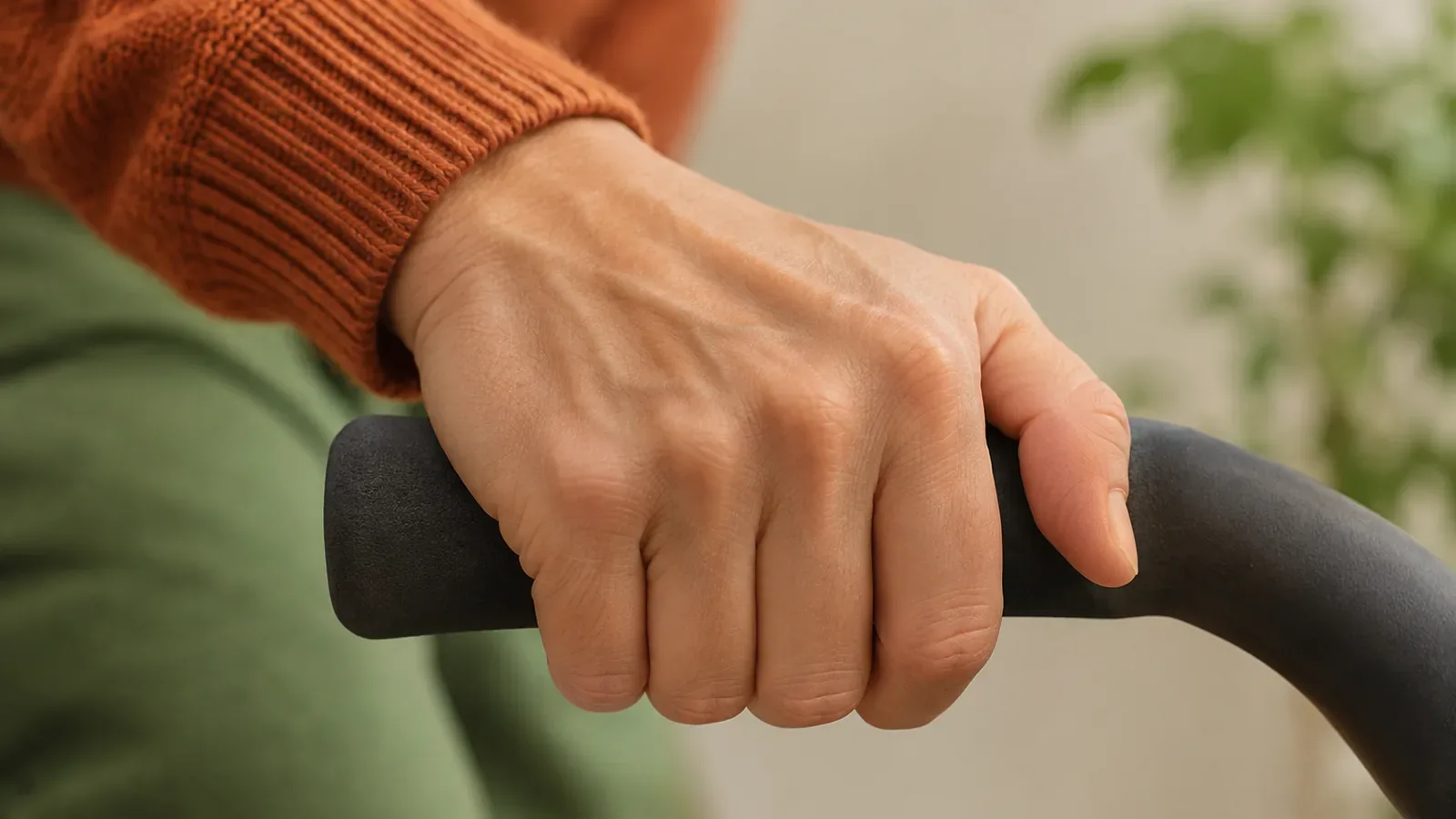
You may know it from a jar lid that won’t budge, or from a suitcase that suddenly feels heavier than it used to. The hand is one of the places where you notice strength loss in daily life fastest. What many people don’t expect is that grip strength tells you more than how hard you can squeeze.
Researchers have used hand strength as a simple marker for years. It is measured with a device called a hand dynamometer and takes only a few seconds. That’s exactly what makes it interesting: a test that needs no lab and can be copied at home still offers clues about the condition of the whole body.
This article explains why grip strength is so informative, what large studies have found, and where the research is still uncertain. You’ll also get practical tips for keeping your hand and body strength up in everyday life.
What exactly is grip strength?
Grip strength is the maximum force you can produce when you wrap your hand around something and squeeze. It is usually measured while seated, with the elbow bent at a right angle, after a short warm-up. You squeeze the handle of the device as hard as you can, and three attempts per hand are common. The result is reported in kilograms or newtons.
Grip strength is a combined measure. Many muscles in the forearm and hand work together, and nerves, joints and coordination all play a part. A weak grip therefore doesn’t always come down to the muscles in your hand.
Why does hand strength say something about the whole body?
The key point is this: the strength of your hand reflects your overall muscle strength fairly reliably. Researchers who study muscle strength and aging often use grip strength as a stand-in for the strength of the whole body. The reason is practical. Not everyone can bring a leg press or a squat test into a study or a doctor’s office. A hand dynamometer fits in a drawer.
Muscle matters for more than looks. Muscle tissue burns more energy at rest than fat tissue does, and strong muscles help you catch yourself when you stumble and manage daily tasks on your own. If you lose muscle strength over the years, every flight of stairs gets harder. So grip strength reflects not only the state of your hand but also part of your physical reserves.
What do the studies say about grip strength and life expectancy?
A large review pulled together data from many cohort studies across several countries. The finding: people with lower grip strength had, on average, a higher risk of early death, even after accounting for age, sex and other factors. Similar links showed up for cardiovascular disease and for limitations in daily life, such as getting up from a chair or carrying groceries.
How you read these results matters. These are observational studies. They show that people with weaker grip die earlier more often. They do not prove that a stronger grip makes you live longer. Behind low grip strength you may find chronic illness, little movement, poor nutrition, or simply older age. The studies adjust for many of these factors, but never for all of them.
What does this mean for you specifically?
Grip strength is a warning light, not a verdict. If it declines over the years, it’s worth looking for the cause. Are you moving less during the day? Has your diet changed? Have new aches or complaints appeared? A single reading tells you little. The trend over months and years tells you much more.
Where is the research still uncertain?
The biggest open question is how strongly grip strength predicts outcomes compared with other measures. Some studies find it predicts about as well as a walking test or the number of times you can stand up from a chair without using your arms. Others see differences. There are also no agreed cutoffs that define a low grip strength. Reference values depend on sex, age and height, and they vary from study to study.
It is also unclear whether targeted hand training changes life expectancy. For strength training in general, there is good evidence that it improves muscle strength and physical function. Whether that translates directly into more years of life in healthy people has not been firmly established. Be skeptical of the hype around particular exercises or gadgets.
How can you keep your grip strength up in daily life?
The good news is that you don’t need a gym or a measuring device to do something for your hand and body strength. Consistency matters more than any special exercise. Here are a few habits that fit easily into a normal day:
- Carry instead of rolling: Now and then, carry your groceries in your hands rather than wheeling everything. It works your grip and forearms without any extra effort.
- Use everyday grips on purpose: Open jars, wring out dish towels, rake leaves or dig with a shovel. All of these put real demand on your hand.
- Strength moves with minimal equipment: Two or three sessions a week are often enough to notice a difference. Chair squats, wall push-ups or lifts with a water bottle full of water are easy starting points.
- Hand exercises: A soft ball to squeeze, or opening and closing a rolled-up towel, keeps your hand mobile.
- Keep going rather than aiming for perfect: Five minutes on five days beats one long session a month.
If you like, measure your grip strength once a year, for example at a checkup or in a fitness class. That way you can see whether the trend is heading in one direction and act early if needed.
When should you see a doctor?
If the strength in your hand or arm drops noticeably within a few weeks, if you start dropping things, if you notice weakness on only one side, or if numbness and tingling come along with it, get it checked promptly to find out what’s behind it. It also makes sense to talk with your primary care doctor if everyday movements are becoming steadily harder.
Poor grip strength on its own is not a diagnosis. Doctors can use simple examinations to determine whether muscles, nerves or joints are the cause, and what can help.
Key takeaways
- Grip strength, the force you can squeeze with your hand, is considered a simple proxy for your overall muscle strength in research.
- In large observational studies, lower grip strength was linked to a higher risk of early death and of everyday limitations.
- Grip strength is an indicator, not a diagnostic tool: it shows associations, not causes.
- You can keep your hand strength up through everyday movement and simple strength training over the years, and you don’t need a measuring device to do it.
- If your strength drops noticeably or you feel unusually weak, have it checked by a doctor.
Frequently asked questions
Can I read my life expectancy from my grip strength?
No. The studies show averages for large groups, not predictions for individual people. A low grip strength is a signal that should be considered together with other findings.
How do I measure my grip strength?
The most accurate way is with a hand dynamometer, the same kind used in clinics and studies. Without a device, you can only roughly judge how easily everyday grips come to you. For tracking changes over years, a regular measurement at a checkup or in a fitness class is most informative.
Is a special hand trainer the best way to build grip strength?
Hand trainers can strengthen your hand, but for overall muscle strength, full-body training matters more. Research mainly shows that general strength training improves muscle strength and everyday function. Everyday grips and simple exercises are usually enough to get started.
Does grip strength differ between women and men?
Yes. On average, men have higher grip strength than women, and it declines with age. That’s why results are always compared with values for sex and age group. A comparison with other people tells you little about your own health on its own.