Do your thighs burn faster on the stairs than they used to? Or does lifting a case of water feel harder than it did a few years ago? Moments like these make you wonder when your muscles actually start to pull back.
The short answer: muscle loss starts gradually, and earlier than most people expect. The longer answer is more encouraging. Muscles keep responding to training well into old age, and a large part of the loss can be influenced.
Below, we look at what is known about the timeline, where the evidence is still unclear, and which habits have been shown to help.
At what age do we start losing muscle mass?
Muscle mass usually peaks in your 20s and 30s. After that, it declines slowly. Specialists call the age-related loss of muscle mass and strength sarcopenia. The word comes from Greek: “sarx” (flesh) and “penia” (deficiency).
How fast this happens depends on the study. Often-cited reviews suggest that adults lose a small percentage of muscle each year from around age 30. One frequently quoted estimate, for people who don’t train, is about one to two percent per year. Treat that figure as a rough guide drawn from cross-sectional and longitudinal studies, not a fixed rule. It doesn’t apply equally to everyone. It depends heavily on how active you are, how you eat, and whether you have any health conditions.
Around age 60, the loss becomes more pronounced in many studies. People lose not only mass but, above all, strength. That’s an important difference: strength per kilogram of muscle often drops faster than the muscle itself. So a number on the bathroom scale tells you little about how well your muscles work in daily life.
Why do muscles shrink?
Several processes overlap. Muscle fibers tend to get smaller with age, and the number of muscle stem cells that help with repair and growth goes down. Hormonal changes come into play, along with a weaker response to protein signals after meals, and often less movement. Researchers largely agree that inactivity is one of the biggest drivers. If you go for years without lifting or carrying much of anything, your muscles lose ground faster.
Can muscle loss be slowed down?
Yes, and the evidence here is reassuringly clear. Guidelines and reviews name strength training as the best-supported way to counter age-related muscle loss. Even people over 80 can increase their strength and, in some cases, their muscle mass when they train regularly and gradually increase the load. Controlled studies in geriatric settings have shown this.
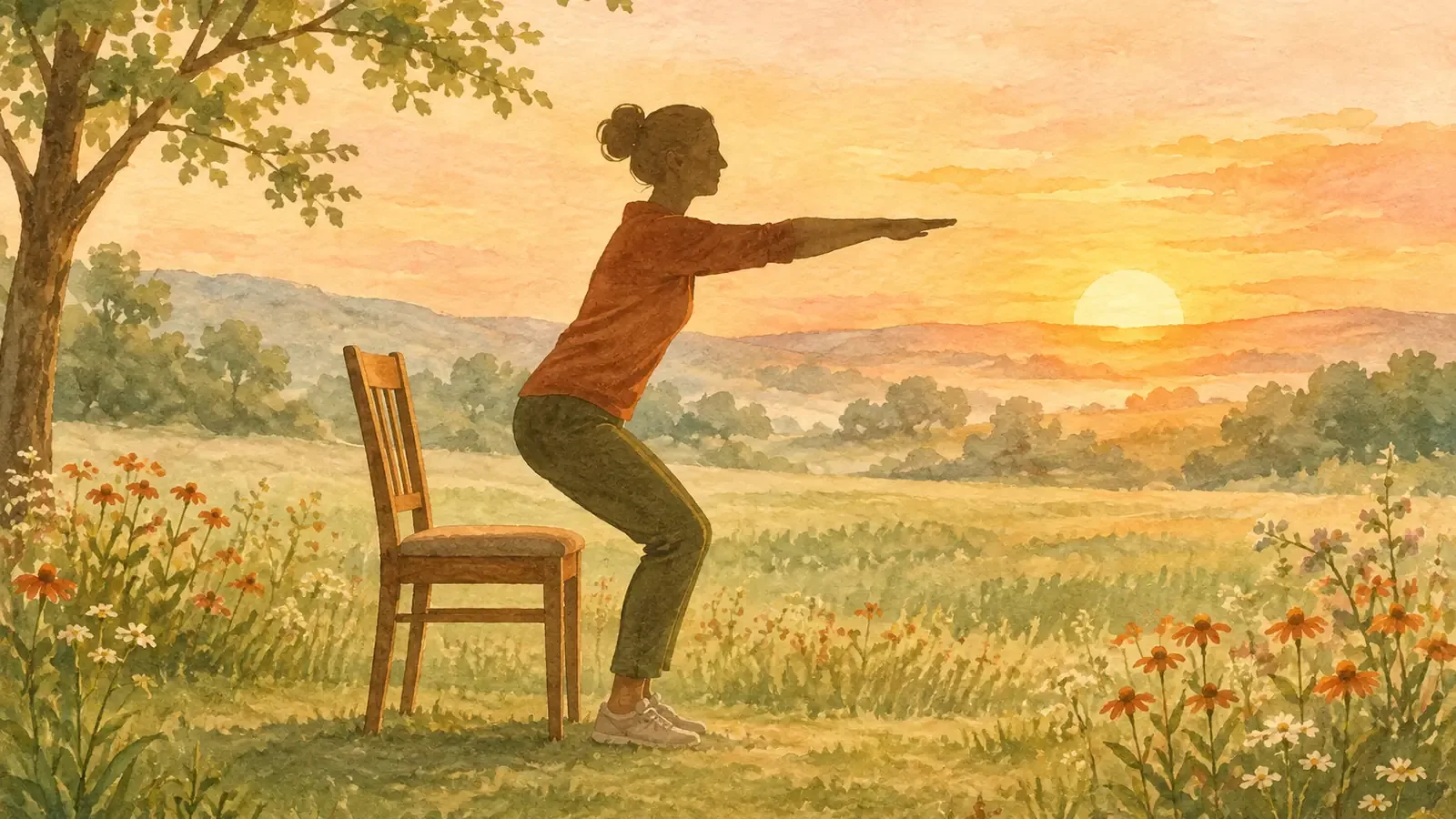
The key is the load. You don’t need a gym membership. What matters is that your muscles are challenged well beyond what daily life asks of them. Typical exercises include sit-to-stands from a chair, lunges, calf raises, and wall or kitchen-counter push-ups. The WHO’s physical activity recommendations, among others, suggest muscle-strengthening activity on at least two days a week that works all the major muscle groups.
The role of protein
Protein supplies the building blocks for muscle tissue. The German Nutrition Society notes that older adults need somewhat more protein per kilogram of body weight than younger adults, because the body responds less strongly to stimulus. How much is sensible for you depends on your health, kidney function and activity level. Age-based protein recommendations are a useful starting point for checking your own intake. There is no fixed number at which the decline stops.
What does this mean for your everyday life?
You don’t have to overhaul your whole life. Small, regular steps work better than a burst of enthusiasm that fizzles out after two weeks. These ideas fit into most days:
- Two strength sessions a week: 20 to 30 minutes is enough to start. Eight to ten simple exercises, done twice each, will do the job.
- Train with awareness: The last two or three reps should feel hard but still be done with good form. That tells you the load is doing its job.
- Take the stairs: Everyday loading keeps muscles in use and is an easy way to begin.
- Spread protein across the day: A serving of protein at each main meal, such as yogurt, eggs, beans, lentils or fish, is a simple framework.
- Practice balance: Stand on one leg while you brush your teeth. This helps guard against falls, which often lead to injuries later in life.
If you want to get a sense of how much movement you get overall, the step counter calculator can help you put your daily routine in perspective.
Where is the research still uncertain?
Plenty remains open. Researchers are still debating how muscle mass, muscle strength and physical function relate to one another. The ideal protein intake for very old or frail people is not settled in every detail. Many studies are small or run for only a few months, and long-term data spanning decades are largely missing. What you can take away is that the direction is consistent across nearly all studies: movement and strength training preserve muscle at every age.
When should you see a doctor?
If you notice that you’re losing weight without meaning to, that your strength in everyday tasks is clearly declining, that you tire quickly, or that getting up from a chair has become a struggle, talk to your family doctor. The causes can vary, and some of them are very treatable. It’s worth getting checked before you chalk the change up to age or habits.
For more background, see our guide Healthy Aging: 8 Tips for a Long Life in Everyday Life.
Related topics
Key takeaways
- Muscle mass starts to decline slowly from about age 30, and for many people the change is barely noticeable at first.
- From around age 60, the loss becomes more pronounced in many studies, but how strong it is varies widely from person to person.
- Strength training is the best-supported way to keep or rebuild muscle as you get older.
- Enough protein and everyday movement support muscle retention. There is no fixed number at which the decline stops.
- If you lose strength, tire more easily than usual or lose weight without trying, talk to your doctor.
Frequently asked questions
Do I really start losing muscle at 30?
Yes, according to many review articles the decline begins around age 30, but it is very slow. In daily life you usually don’t notice it for a long time. Regular strength training can noticeably slow the loss.
Is it too late to start strength training?
No. In controlled studies, people in their 70s and 80s have increased their strength. The key is a gradual start with light loads and steadily increasing demands.
Do I need protein supplements to keep my muscles?
Most people can meet their needs with a balanced diet that includes enough protein from foods. Powders and shakes are not necessary. If you have questions about your diet as you age, a nutrition counselor or your doctor can help.
How do I know if my muscle loss is no longer normal?
Warning signs include unintended weight loss, clearly reduced strength, frequent falls or difficulty getting up from a chair. If you notice these, see a doctor so possible causes can be checked.