Do you have a blood pressure monitor at home and wonder whether the numbers it shows are accurate? That is a good question. A blood pressure reading is only as reliable as the measurement behind it. Even small mistakes in how you sit, how you put on the cuff, or when you measure can shift the result by several millimeters of mercury (mmHg). A reading can then look too high or too low even when everything is fine.
Because high blood pressure often causes no symptoms, home monitoring is valuable. It shows how your numbers behave in everyday life and gives your healthcare provider information that a single snapshot at the doctor’s office cannot. The key is measuring correctly.
Below, you will learn what matters most, which mistakes happen most often, and how to build a routine you can actually stick with.
How does blood pressure measurement work?
Blood pressure is the force your blood exerts against the walls of your arteries. The top number (systolic) is the pressure when your heart contracts and pushes blood out. The bottom number (diastolic) is the pressure when your heart rests between beats. For more on what these two numbers mean, see our article on healthy blood pressure ranges.
Most automatic upper-arm monitors inflate the cuff until blood flow in the brachial artery is briefly stopped. As the air slowly releases, the device detects when blood starts flowing again and when the pulse waves become regular. From these signals it calculates the two numbers. A monitor can only be as accurate as the conditions you give it.
Which mistakes affect the reading most often?
Many measurement errors seem harmless in daily life but can noticeably change the result. These are the pitfalls that come up again and again:
- Measuring right after coffee, nicotine, or exercise: Caffeine and nicotine can raise blood pressure for a short time, and so can physical exertion. After exercise or coffee, wait about 30 minutes. Do the same after smoking.
- Sitting down and measuring immediately: After climbing stairs or carrying groceries, your body is still active. Sit quietly for about five minutes first.
- A full bladder: Needing to urinate can also affect your readings. Empty your bladder before you measure.
- Talking, watching TV, or using your phone: Conversation and mental tasks can push the number up. Sit still and do not talk during the reading.
- Crossing your legs: This often raises blood pressure noticeably. Keep both feet flat on the floor.
- Holding your arm unsupported: If your arm is not at heart level, the reading will be off. Rest your arm on a table so the cuff sits at about heart height.
- Clothing over the upper arm: Tight sleeves squeeze the arm and distort the reading. Roll up your sleeve without constricting it.
How do I put the cuff on correctly?
The cuff is the most common source of technical error. If it is too small, readings tend to come out too high. If it is too large, they tend to come out too low. The right size depends on your upper arm circumference, which is usually listed on the box or in the manual. Measure around the middle of your upper arm, halfway between your shoulder and your elbow.
Step by step
- Choose a cuff that matches your upper arm circumference.
- Place it on your bare or lightly clothed upper arm, about two to three centimeters (roughly one inch) above the bend of your elbow.
- The cuff should feel snug but not tight. You should usually be able to fit one finger between the cuff and your arm.
- The artery marker (often an arrow or symbol) should point toward the inside of your elbow, over the artery.
- Rest your arm on a table edge so the cuff is at heart level.
Wrist monitors: Are they worth it?
Wrist monitors are compact but more sensitive to arm position and movement. For home use, professional societies generally recommend upper-arm devices. If you use a wrist monitor, pay especially close attention to holding your wrist at heart level.
How often and when should I measure?
A single reading tells you little, because blood pressure changes throughout the day. Series of readings are what count. A commonly used approach is to measure in the morning and in the evening, before taking any prescribed medication, taking two readings about one to two minutes apart and recording the average. Ask your doctor or nurse how often you should measure, since the right schedule depends on your situation.
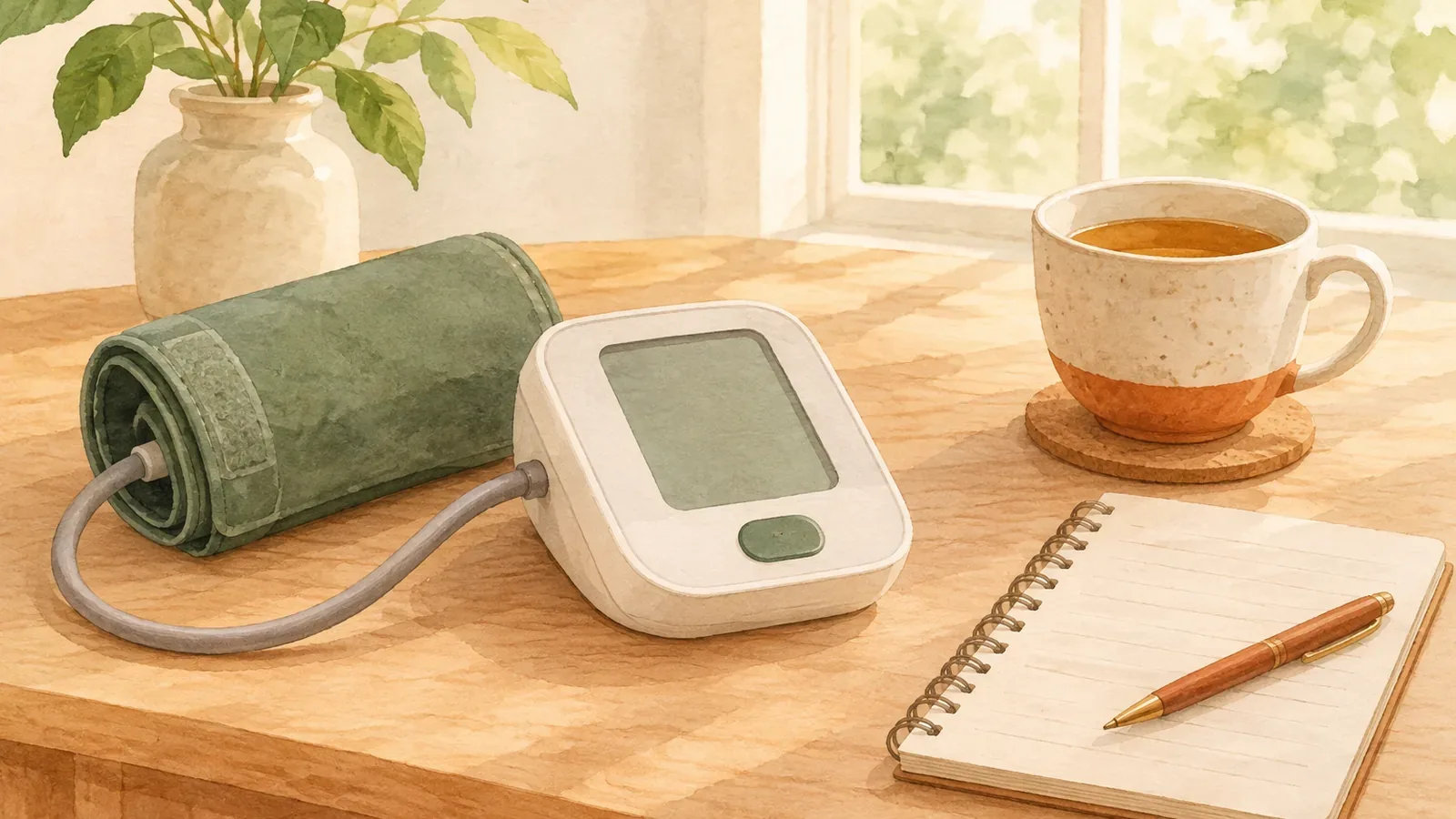
A blood pressure log helps you spot patterns. Write down the date, time, both numbers, your pulse, and brief notes about anything unusual, such as stress, poor sleep, or missed medication. This turns a set of numbers into a clear record that your healthcare provider can work with.
Why do home and office readings differ?
Many people have higher readings at the doctor’s office than at home. This is often called white coat effect. Nerves before the appointment, walking into the exam room, or waiting can raise your number for a while. The reverse can also happen, with home readings sometimes running lower than office readings. For this reason, home readings are often considered more informative when they are collected over several days. Clinicians may also use a 24-hour ambulatory monitor, which records readings across the day and night. Ask your provider which approach makes sense for you.
Which myths about blood pressure monitoring are not true?
A few misconceptions keep coming up:
- “One reading is enough.” Single readings can be randomly high or low. The trend over several days matters more.
- “If I feel fine, my blood pressure is fine.” High blood pressure often causes no symptoms for a long time. That is why measuring is useful even when you feel well.
- “The monitor is always right.” Devices can drift out of calibration. Comparing your home monitor with a reading at the doctor’s office now and then can reveal a difference.
- “Tighter is better.” Do not overtighten the cuff. Fit it the way the instructions describe.
Practical tips for a routine that fits your day
- Keep your monitor and cuff in one fixed spot so you do not have to hunt for them.
- Measure at the same times each day, for example after waking and using the bathroom in the morning, and again in the evening before bed.
- Link the measurement to a habit you already have, such as brushing your teeth.
- Sit quietly for five minutes before measuring, with no phone and no conversation.
- The first time, measure both arms to see which one gives higher readings. Then use that same arm for future measurements.
- Write down values right away rather than trying to remember them later.
- Check the batteries and the cuff size from time to time.
When should you seek medical advice?
If your readings over several days are consistently high, contact your primary care provider and bring your log. Get medical help right away if a very high reading appears together with severe headache, chest pain, shortness of breath, vision changes, numbness, or weakness. In the United States, call 911 in an emergency.
Key takeaways
- An accurate home reading depends on sitting quietly, wearing the cuff correctly, and resting your arm at heart level.
- The most common mistakes are measuring right after coffee, exercise, or smoking, using a cuff that is too small or poorly positioned, and talking during the reading.
- For meaningful results, measure at the same times each day, take two readings a minute or two apart, and record every value in a log.
- A single high reading is not a diagnosis; a healthcare professional judges whether your blood pressure is consistently elevated based on several measurements.
- For very high readings or symptoms such as severe headache, chest pain, or vision changes, seek medical help right away.
Frequently asked questions
Which arm should I use for blood pressure measurement?
The first time, measure both arms and note which one gives higher readings. Then use that same arm for all future measurements so your values are comparable. Your provider can tell you whether a difference between arms needs follow-up.
How long should I wait after coffee before measuring?
Wait about 30 minutes after coffee, nicotine, or exercise before you measure. Sit quietly for a few minutes first. This reduces short-term effects on the reading.
When is a home blood pressure reading not reliable?
Readings are limited if the device is used incorrectly, the cuff does not fit, or you measure right after physical activity. A home monitor can be checked for accuracy by comparing it with a reading taken at your doctor’s office.
Is one high blood pressure reading enough to diagnose high blood pressure?
No. A single reading can be caused by stress, nerves, or a measurement error. A healthcare professional determines whether your values are consistently elevated based on several measurements over a period of time.