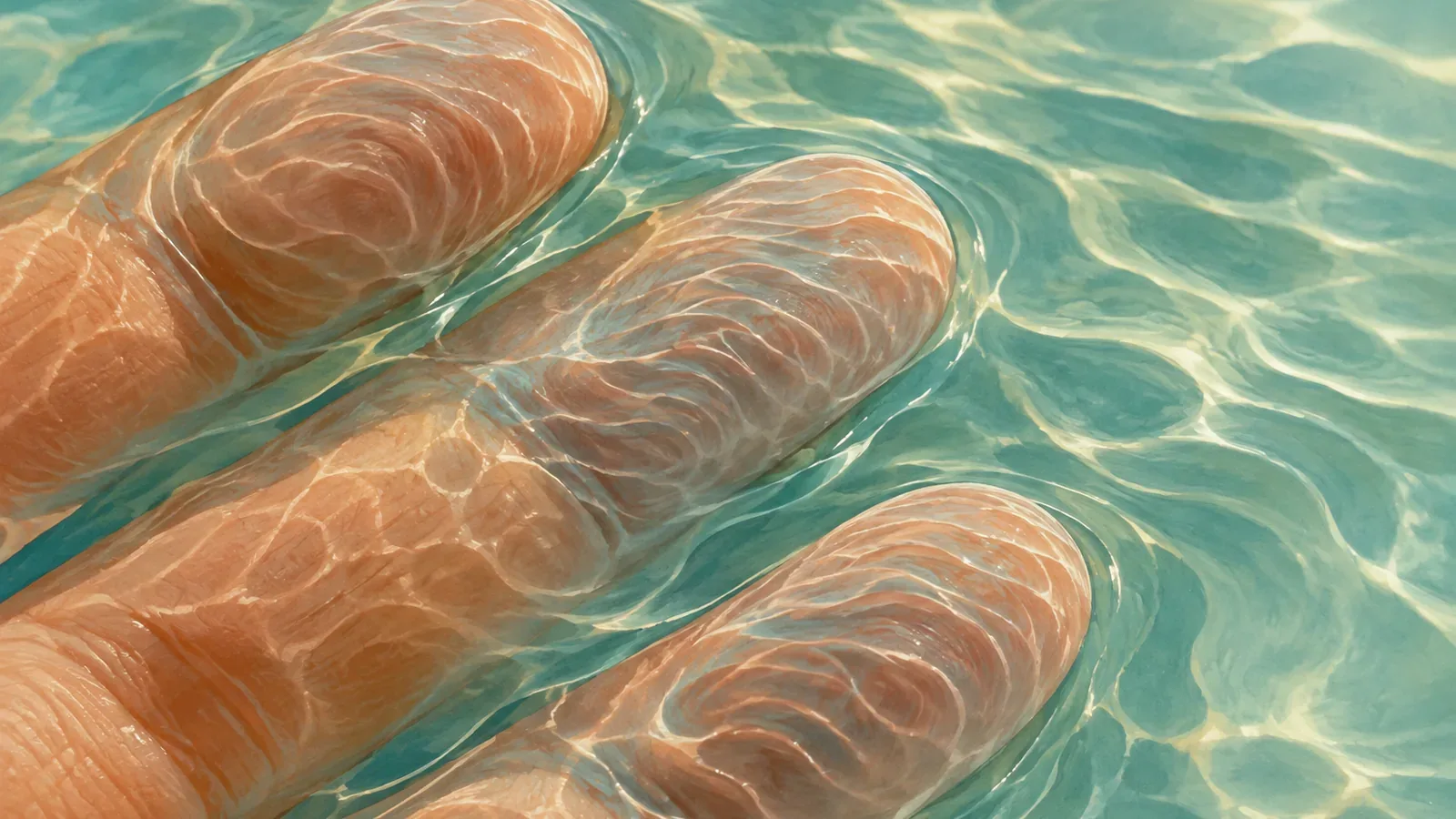
You probably know the feeling. After a long bath or an afternoon at the pool, your fingertips look like they’ve been left in the sun to dry into raisins. And usually the pattern fades just as quickly once your hands are dry. So why does it happen, and why mostly on fingers and toes?
The short answer: the skin swells, and your nervous system tightens things up. The longer answer is more interesting, and it includes a question that researchers haven’t fully settled.
What happens in the skin when it gets wet?
The outermost layer of your skin, the stratum corneum, is made of dead skin cells stacked a bit like bricks in a wall. Fats sit between them and keep the skin flexible and water-resistant. When you stay in water for a while, that outer layer takes up moisture and swells. Doctors call this maceration when skin softens from prolonged wetness.
That sounds harmless, but it doesn’t fully explain the pattern. The wrinkles show up mainly on fingers and toes for two reasons: the skin there is thicker in places, and it bends sharply over a small area. When the top layer swells, it has nowhere to expand, so it crinkles.
Why only fingers and toes?
This is where things get surprising. A 2011 study suggested that wrinkling is not just a swelling effect. The findings, published in the journal Medical Hypotheses, point to the narrowing of blood vessels under the skin as part of the story. That narrowing is a reaction of the autonomic nervous system, the part of your nervous system that works without you thinking about it, the same system that handles your heartbeat and digestion.
Some older observations also seem to support this. People with nerve injuries in their fingers have been reported to still wrinkle when wet, which would argue against a purely local swelling process. The evidence here is thin, though, and the explanation is not fully confirmed.
The grip hypothesis
One idea is that the ridges on wet fingers work a bit like tread on tires. They channel water away from the contact surface and may help you hold on to something slippery, like a wet glass or a rope. In an experiment with volunteers, people with wrinkled fingers picked up wet marbles a little more reliably than people with smooth fingers. Whether this is really why the effect exists is still debated among specialists, and a later study did not find the advantage in every test. So the grip idea is plausible, but it is not a settled result.
This is typical for body-curiosity questions: the answer depends on how closely you look. A trait can be useful and still come from a mechanism that was originally meant for something else.
Why does the pattern go away?
Once you dry off, the cells in the outer skin layer release the water they absorbed, and the skin tightens and smooths out again. This usually takes somewhere between a few minutes and about an hour. How fast it happens depends on water temperature, humidity, and how thick your skin is. If you were in the water for many hours, expect it to take longer.
Why you don’t need to fear the water
Wrinkly skin is a sign that your skin got wet, not a sign that it was damaged. It also has nothing to do with how much water you drink. You may have heard that you should drink extra water after a swim to “replace” what soaked in, but that is a myth. Your body manages its fluid balance through your kidneys and your sense of thirst, not through your fingertips.
Practical tips for everyday life
- Before long swims or baths: If you want to keep your hands dry, for example while cooking with sensitive skin, gloves are an easy fix. It’s purely a matter of comfort.
- After a shower: Skin that has been wet for a long time is softer and can react more to friction. Pat dry rather than rubbing.
- Dry skin afterward: If your hands feel tight after washing them often, a gentle moisturizer without strong fragrance is a simple option.
- Playing in the water with kids: Wrinkly fingers are a sign that the skin is doing what it should. There’s no need to worry.
When should you see a doctor?
Wrinkled fingers in water are harmless and go away on their own after drying. Get medical advice if the wrinkles don’t fade after you dry off, if you notice numbness, tingling, or pain in your fingers, or if only one hand is affected. In those cases, something else may be behind the change, and it’s worth having it checked.
Key takeaways
- The skin on your fingertips softens in water because the outer layer, the stratum corneum, takes up moisture and swells.
- The wrinkling itself is not just swelling: it is also controlled by the autonomic nervous system, which narrows the blood vessels under the skin.
- A 2011 study by Mark Changizi and colleagues linked the effect to gripping wet objects. Check the original source before citing it, since the details are not fully settled.
- Researchers do not fully agree on what the effect is for. Some experiments suggest a better grip, but the results are mixed.
- Wrinkled fingers are harmless. See a doctor only if they stay wrinkled after drying or if you notice numbness or other sensation changes.
Frequently asked questions
Why do my fingers wrinkle in water but not when my hands are just damp?
In water, the outer layer of your skin takes up much more moisture than it does from damp hands. It swells more, and the skin on your fingertips can visibly crinkle. At normal humidity there usually isn’t enough moisture for that.
Can fingers that wrinkle quickly be a sign of diabetes?
No, wrinkled fingers in water are not a sign of diabetes. What matters is whether the change stays after you dry off or comes with numbness or other sensation changes. If it does, talk to a doctor.
Why does the pattern disappear after I dry off?
The outer skin layer releases the water it absorbed, and the skin tightens and smooths out again. This usually takes a few minutes to about an hour, depending on how long you were wet, the water temperature, and how thick your skin is. After very long exposure it can take longer.
Do wrinkly fingers really help you grip things underwater?
That is a hypothesis that held up in some experiments but not in all of them. The research is not conclusive. What is established so far is only that the skin changes in this way when wet.