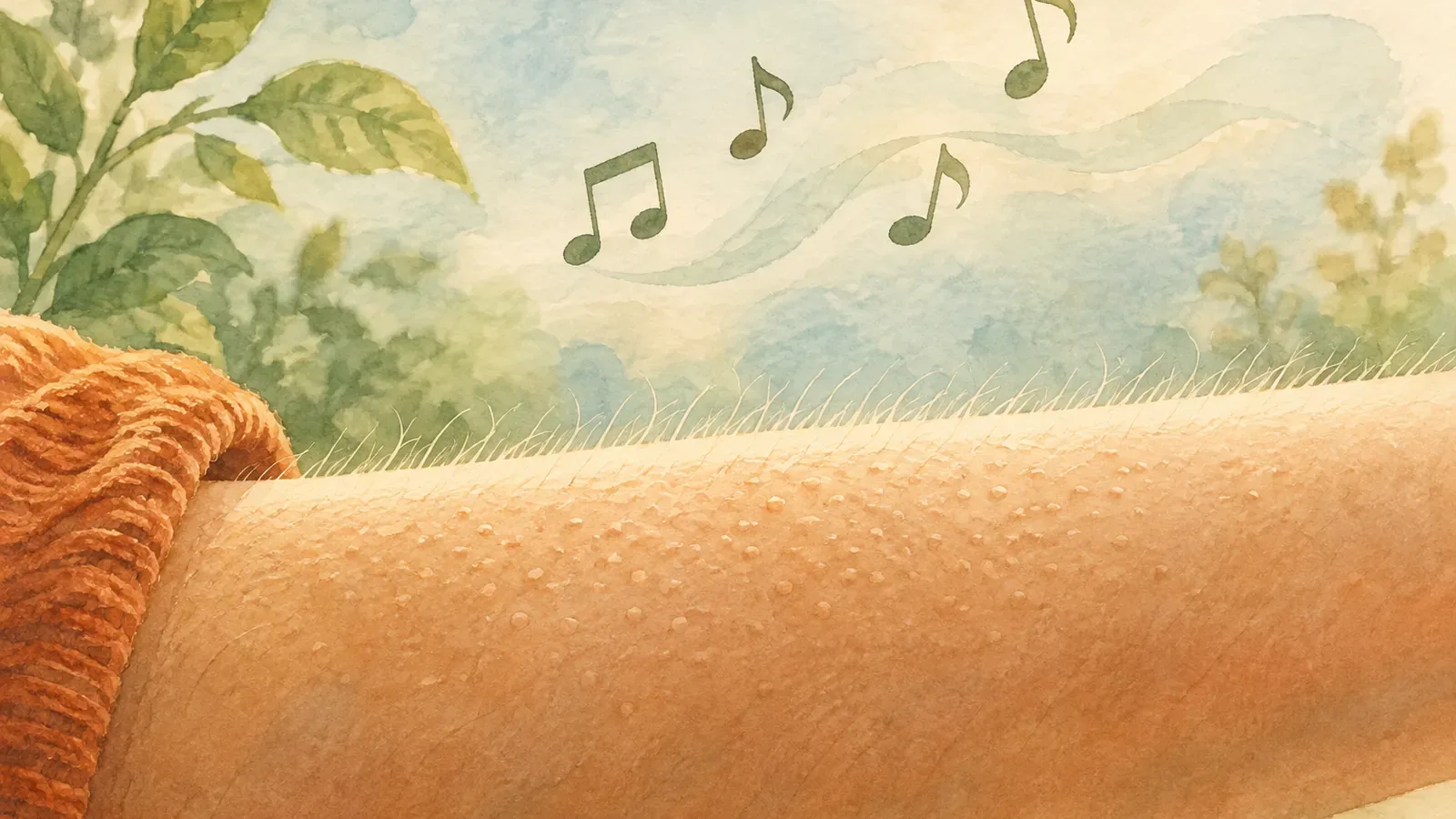
You’re listening to a song, and suddenly a chill runs down your arms. The hairs stand up, small bumps form on your skin, and you feel like you’ve just walked into a field of goose feathers. The name actually comes from that picture: a plucked goose has skin that looks a lot like a person with goosebumps. Scientists call the effect piloerection, which simply means “hair erection.”
Compared with most mammals, we humans have very little fur. Even so, every hair follicle still carries the reflex. It’s a leftover from a time when our ancestors were much more hairy. What exactly is going on, and why a particular song or a movie scene sets it off, is more interesting than it sounds.
How do goosebumps form in the body?
Every hair sits in a small follicle, and attached to each follicle is a tiny muscle. It’s called the arrector pili muscle. This muscle is smooth, so you can’t control it on purpose. It’s run by the autonomic nervous system, the part of your nervous system that works without you thinking about it, like your heartbeat and digestion.
When the muscle contracts, it pulls the hair upright. At the same time it pushes the skin around the follicle slightly up, and that creates the small bump you feel as goosebumps. The whole thing takes just a few seconds.
Why cold makes your skin prickle
The most familiar trigger is cold. When you get chilly, your body switches to holding on to heat. The reflex is probably a relic from the days when thick fur really did insulate. Raised hairs trap a layer of warm air close to the skin. In humans this barely helps, because our hairs are too short and too thin to do much. The reflex stuck around anyway.
Why do you get goosebumps from music?
Goosebumps from music, movies or a powerful conversation have nothing to do with temperature. They show that emotional triggers reach the same system that responds to cold or danger. Researchers who have studied which musical moments give people goosebumps have found that these are often moments when a expectation is built up and then surprisingly met or broken, such as a sudden entrance after a long pause.
Brain imaging studies suggest that when people listen to especially moving music, areas linked to reward and emotion become active, including regions that release dopamine. The exact chain from brain activity to the tiny muscle in your skin is still not fully understood. Honestly, this is one of those topics where research still has plenty of open questions.
That also explains why some people get goosebumps from the same songs that leave others cold. Personal taste in music, memories tied to certain moments and the way you react to surprises all play a part. Studies have also described a link with the personality trait called openness to experience, but that’s no proof of a fixed rule.
Goosebumps from fear and disgust: what’s behind them?
Goosebumps can also show up with fright, shock or disgust. Here the autonomic nervous system is working in its alarm mode. Your body gets ready to act fast, and your heartbeat, breathing and muscle tension all shift. The raised hairs are more of a side effect than a useful defense. Still, the reflex works like a signal: something matters right now.
Why the reflex matters more for animals
In many mammals, piloerection has a clear job. Cats puff up their fur to look bigger and more threatening. Hedgehogs and porcupines raise their quills, which grew out of similar hair structures. In humans there’s little left of that function, apart from the fact that we show something similar when we’re startled, just without a visible effect.
Can goosebumps signal something serious?
Usually not. Goosebumps are one of the harmless body reactions. They become a reason to pay attention when they keep coming back for no obvious reason, or when they show up alongside fever, chills, weakness or other new symptoms. Lasting changes in your skin should also be looked at by a doctor. Dermatologists generally advise seeing a doctor whenever you’re unsure about a skin change.
Practical tips: understanding and using your goosebumps
- Dress warmly early: One extra layer keeps your body from reaching for its old trick in the first place. That does more for you than any theory.
- Listen to music on purpose: If a song hits you regularly, pay attention to the exact moment. It’s often a stretch of tension or an unexpected change.
- Notice patterns: If goosebumps show up in certain situations, such as in the shower or during certain conversations, think about whether cold, stress or anticipation is behind them.
- Build in breaks when you’re stressed: If you often feel wired on the inside, your nervous system can react faster. A few short breaks with slow, deep exhales can help you find your balance again.
When should you see a doctor?
If goosebumps come with fever, chills, night sweats, unexplained weight loss or ongoing tiredness, talk to a doctor. The same goes for a skin change that doesn’t go away. Your primary care doctor is a good first stop for sorting out what’s going on.
Key takeaways
- Goosebumps are piloerection: tiny muscles attached to each hair follicle contract and make the hairs stand up.
- In humans this reflex hardly protects us anymore. In animals it helps fluff up fur and makes them look bigger.
- Cold is the classic trigger, but goosebumps can also come from fear, surprise or strong feelings while listening to music.
- With intense emotional reactions, goosebumps are part of an interplay between the nervous system, hormones and anticipation that research does not yet fully explain.
- Goosebumps on their own are harmless. If they happen unusually often or come with other symptoms, it’s worth checking in with a doctor.
Frequently asked questions
Why do you get goosebumps when you’re not cold at all?
Emotional triggers like music, surprise or fear can also activate the tiny arrector pili muscles. The reflex doesn’t depend on temperature alone. It belongs to the autonomic nervous system, which reacts without conscious control to feelings and expectations.
Did humans get goosebumps because we used to have fur?
That’s the most likely explanation scientists currently accept. The reflex probably dates back to a time when thicker fur held in warmth and made animals look bigger. For humans today, its practical use is small.
Can you trigger goosebumps on purpose?
Not directly, because you can’t consciously control the muscle. You can, however, seek out situations that tend to cause them, such as a moving piece of music or a cold room. In that sense you can influence the reaction, though not switch it on.
Do all people get goosebumps from music?
No, the response varies a lot from person to person. Your taste in music, personal memories and the way you react to surprises all shape whether and when you get goosebumps. Some people rarely experience them, while others feel them regularly.