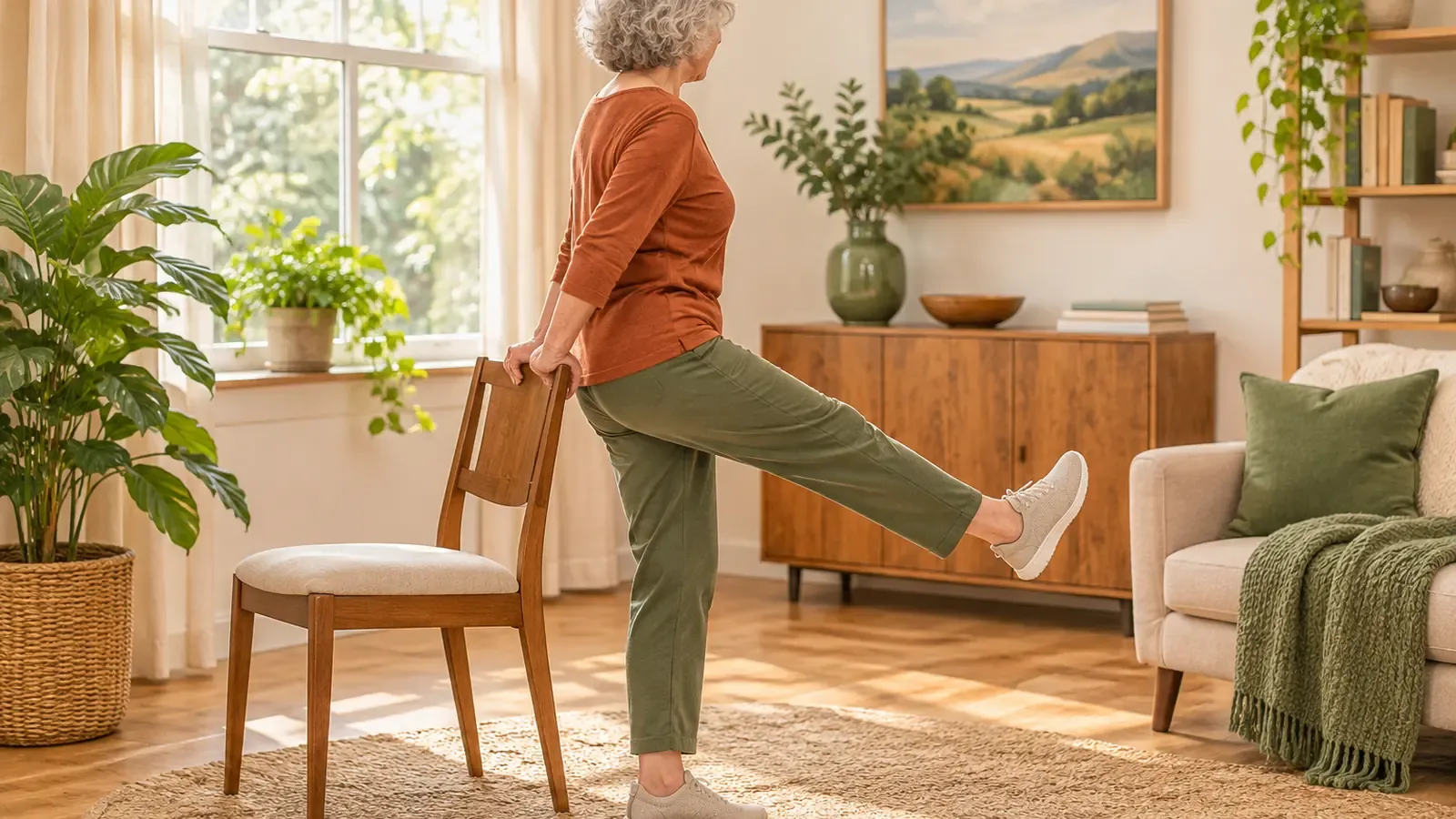
Your knees and hips carry a lot of weight in everyday life. Climbing stairs, shopping and getting up from a chair all put load on the joints. When osteoarthritis, a progressive wear of the joint cartilage, is diagnosed, many people wonder whether they should now rest more. The good news first: current guidelines generally do not recommend rest for osteoarthritis, but movement.
This may come as a surprise. Yet joints need movement to be supplied with nutrients, and well-trained muscles noticeably take pressure off the joint. Many people with osteoarthritis find that pain and stiffness decrease with suitable movement and that everyday function improves.
This guide shows which exercises are suitable for osteoarthritis in the knee and hip, what you should pay attention to, and how to dose movement so that it does you good.
Why movement matters so much in osteoarthritis
Cartilage has no blood supply of its own. It is nourished mainly by the synovial fluid, which spreads through the joint when you move. At the same time, strong muscles act like a natural shock absorber: a strong thigh muscle absorbs part of the load that would otherwise hit the knee joint directly when you walk or climb stairs.
In addition, exercise improves endurance, body weight and overall well-being. Excess weight in particular increases the load on the knee and hip considerably. Even a moderate weight loss can therefore make a difference.
It is important to know: the research shows that exercises mainly improve pain and physical function. To our current knowledge, they do not slow down joint wear in the sense of healing, and they do not fundamentally change cartilage that is already damaged. Their benefit lies in a better everyday life, not in repairing the joint.
Which exercises are suitable for osteoarthritis in the knee and hip?
A combination of three building blocks is usually recommended: strengthening, mobility and endurance. It is good if all three appear in your weekly plan.
Strength: building the muscles around the joint
Strength training is one of the best-studied building blocks in osteoarthritis. Typical exercises for knee and hip include:
- Chair-supported squats: Hold on to a sturdy chair back or worktop and slowly bend your knees into a squat, only as far as is possible without sharp pain. Then stand up again.
- Leg lifts while lying down: Lie on your back, keep one leg straight and slowly lift it until it is level with the other knee. Hold briefly, then lower it.
- Bridge: Lie on your back with your knees bent and feet flat on the floor. Slowly lift your buttocks until your thighs and upper body form a line. Hold briefly and roll down.
- Side leg raise: Lie on your side and lift the upper leg straight up. This strengthens the side hip muscle, which stabilises the pelvis when you walk.
- Calf raises: Standing next to a support, slowly rise onto your toes and lower yourself again.
It is common to repeat each exercise about eight to twelve times and to go through the set two to three times. Adjust the exact number to how you feel. What matters is clean, slow movement without momentum.
Mobility: loosening stiff joints
Gentle stretching and mobilisation exercises keep the joint flexible. These include, for example, circling the hip while standing, sliding your heel along the floor while bending the knee in a seated position, or stretching the back of the thigh. Stretch slowly, hold the position for about 20 to 30 seconds and keep breathing calmly. Jerky, bouncing movements are not necessary.
Endurance: staying active in a joint-friendly way
Endurance exercise gets the heart and circulation going and often helps with weight management. Activities without strong impact are particularly well suited:
- Cycling, including on a stationary bike with adjustable resistance
- Swimming and water aerobics, as the buoyancy of the water relieves the joints
- Brisk walking on level ground
- Nordic walking at a moderate pace
Running on hard surfaces or sports with sudden twisting movements are assessed differently in osteoarthritis. Many people tolerate them well when the joint is stable. Whether this applies to you is best clarified with your doctor or a physiotherapist.
What should you pay attention to when exercising?
Movement should be challenging, but it should not cause harm. As a rule of thumb, slight muscle fatigue and a feeling of mild warmth are normal. Pain that rises sharply, lasts longer than about two hours or is clearly worse the next day, on the other hand, shows that the load was too high.
Also pay attention to the following points:
- Start slowly: Begin with a few repetitions and build up gradually over weeks.
- Use pain as a signal: A dull pulling feeling in the muscles is fine. A stabbing pain in the joint is a reason to make the exercise smaller or stop it.
- Do not train against pain: If you take painkillers in order to exercise anyway, you can easily lose your sense of your limits.
- Regularity before intensity: Several short sessions a week usually work better than a single marathon day at the weekend.
- Watch for swelling: If the knee becomes clearly swollen or warm after training, the load is too high.
Your shoes also play a role. Comfortable, stable shoes with good support make walking and training easier. If you are unsure, you can get advice at a medical supply store or from a physiotherapist.
How do you fit exercises into everyday life?
A training plan does not have to be complicated. Many people benefit from a simple weekly rhythm, for example:
- Daily: 5 to 10 minutes of mobility exercises, for instance in the morning after getting up or in the evening before sleep.
- On 2 to 3 days: strength exercises, 15 to 20 minutes each, ideally with a rest day in between.
- On most days: endurance, about 20 to 30 minutes of brisk walking or cycling. The recommendations for adults add up to about 150 minutes of moderate activity per week.
Everyday habits help too: take the stairs instead of the lift, go for short walks after meals, and move your legs now and then while sitting. If you link the exercises to a fixed habit, such as brushing your teeth or your news break, you are more likely to stick with them.
One final tip: write down what you did and how the joint reacted the next day. After a few weeks, you will be able to see clearly which exercises and amounts suit you.
What is known about the benefits of physiotherapy?
Physiotherapy can help you learn exercises correctly and create an individual plan. Many guidelines recommend supervised exercise therapy for knee and hip osteoarthritis, especially at the beginning. Whether a group, a home programme or a combination makes more sense depends on your situation. A group can also provide extra motivation. A home programme is often easier to fit into everyday life.
When should you seek medical advice?
Have symptoms checked by a doctor if the joint suddenly becomes strongly swollen or feels hot, if the knee or hip gives way or gets locked. Night pain that does not improve, or a clearly reduced ability to walk, are also reasons for an appointment. Talk to your doctor before starting a new exercise programme, especially if you have other health conditions.
Overall, movement is an important building block in osteoarthritis of the knee and hip that, in many cases, makes everyday life easier. With a gentle start, a mix of strength, mobility and endurance, and an open ear for your body’s signals, you can find a form of exercise that suits you.
Key takeaways
- Regular movement and targeted strength training are among the most important building blocks in the treatment of osteoarthritis of the knee and hip, according to current guidelines.
- Exercises that strengthen the muscles around the joint, maintain mobility and improve endurance are most suitable, such as cycling, swimming, walking and bodyweight training.
- Mild muscle soreness after training is normal; persistent or increasing joint pain is a sign that you should adjust the load.
- Planning small, regular sessions every day usually brings more progress than rare, very intense training days.
- If you have severe pain, swelling, joint instability or pain at night, seek medical advice before starting new exercises.
Frequently asked questions
Can I exercise at all if I have osteoarthritis in the knee or hip?
As a rule, yes. Current guidelines recommend movement and training as an integral part of treatment. It is important to choose a suitable load and to pay attention to how the joint responds. If you are unsure, check with your doctor.
How do I know if I am overloading my joint during exercise?
Slight muscle fatigue is normal. A warning sign is joint pain that increases sharply during the exercise, lasts longer than about two hours or is clearly worse the next day. Stronger swelling is also a reason to reduce the load.
Is swimming better than cycling for osteoarthritis?
Both are considered joint-friendly. Swimming relieves the joints particularly strongly thanks to the buoyancy of the water, while cycling is also gentle because your weight is carried by the saddle. Which sport suits you better depends on your preferences, access and symptoms.
Can exercise stop cartilage wear?
Based on current knowledge, this is not reliably proven. However, exercise usually improves pain, mobility and everyday function. It does not restore damaged cartilage, but a well-trained body can cope better with the load.