Protein is the topic that attracts more myths online than almost anything else – right after water. Do you really need protein shakes to get enough? Does too much protein damage your kidneys? Are plant-based sources sufficient? This article cuts through the noise – based on what current research says, not on what fitness influencers and protein-bar ads claim.
What protein actually does in the body
Protein is, after water, the second most abundant component of your body. About 16 percent of your body weight is built from protein structures: muscles, tendons, skin, hair, enzymes, antibodies, hormones. Pretty much anything that does something in the body is made of protein somewhere.
Unlike fat or carbohydrates, the body can’t store protein in any meaningful way. When your needs exceed your intake, it breaks down structures – mostly from muscle. That’s why protein intake isn’t a one-off thing, but a daily one.
What many people underestimate: protein is also directly involved in satiety. A protein-rich meal keeps you full longer than a carb- or fat-heavy meal of the same calorie content. That makes protein the quiet MVP of any sensible diet.
Official recommendations are not the optimum
The RDA of 0.8 g/kg
The official Recommended Dietary Allowance (RDA) for protein in most countries is 0.8 g per kg of body weight per day – 56 g for a 70-kg person. This number is based on older nitrogen balance studies and is meant as a minimum requirement: the amount roughly needed on average to avoid deficiency.
That’s an important distinction. Minimum means: at this intake, no deficiency. It does not mean: at this intake, your body operates optimally.
What more recent research shows
The last 15 years have shifted the picture noticeably. Studies using more modern methods (indicator amino acid oxidation) consistently suggest that the optimal intake for most adults sits closer to 1.2 to 1.6 g/kg – 50 to 100 percent higher than the RDA.
For active people, older adults and those in a calorie deficit, the optimal numbers are even higher. Even official bodies now recommend 1.0 g/kg or more for people over 65, after the older recommendation was recognised as too low.
The right amounts for different life situations
An evidence-based overview, by activity level and life stage:
Mostly sedentary: 1.0–1.2 g/kg
Office job, occasional walk, no targeted training. About one gram per kilo of body weight is plenty. For a 70-kg person, that’s 70 g a day.
Regular exercise: 1.4–1.6 g/kg
If you train moderately three or four times a week (running, cycling, light strength training), a bit more pays off. Around 100 to 110 g for a 70-kg person.
Strength training with hypertrophy goals: 1.6–2.0 g/kg
If you’re actively trying to build muscle, aim for 1.6 to 2.0 g/kg. More than that doesn’t add benefit in studies. So 110 to 140 g at 70 kg.
In a calorie deficit: 1.8–2.2 g/kg
When dieting, protein is especially important to minimise muscle loss. Higher amounts make sense here. At 70 kg, that’s about 125 to 155 g.
Over 60: 1.2–1.5 g/kg
With age, protein utilisation becomes less efficient (research calls this “anabolic resistance”). Higher intake helps counter age-related muscle loss (sarcopenia) – which isn’t a cosmetic issue but one of the most important factors for staying independent in older age.
Animal vs. plant: does it matter?
Animal protein sources (meat, fish, eggs, dairy) usually have a higher “biological value” – they deliver all essential amino acids in a ratio close to what humans need. Whey, milk and eggs are particularly rich in leucine, an amino acid with a strong stimulus on muscle protein synthesis.
Plant sources are often slightly “poorer” in individual essential amino acids – legumes are low in methionine, grains low in lysine. In practice that’s rarely an issue: anyone who combines several plant protein sources over the day (legumes + grains + nuts) automatically gets a complete amino acid profile.
A key 2018 study (Morton et al.) compared animal and plant protein sources directly and found: at equal total protein intake, the effects on muscle building are practically identical. Plant-based eaters don’t need special treatment – just a bit more attention to source variety.
The most important protein sources compared
Per 100 g cooked weight:
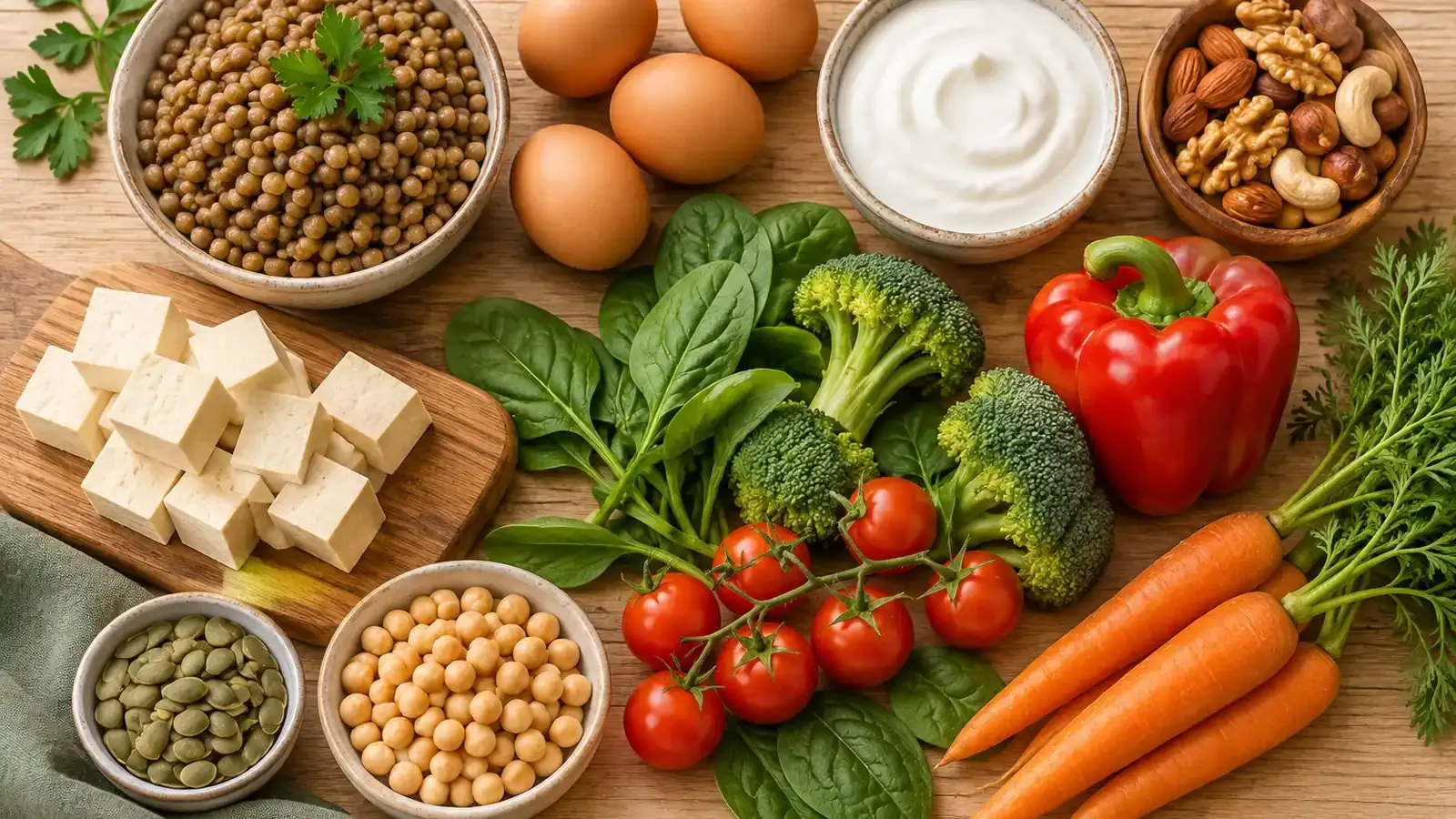
- Quark (low-fat): 12 g – cheap, versatile, high in leucine
- Skyr: 11 g – similar to quark, slightly creamier
- Chicken breast: 31 g – classic athlete’s staple
- Salmon: 25 g – omega-3 as a bonus
- Eggs: 13 g – complete amino acid profile, high bioavailability
- Lentils, cooked: 9 g – cheap and high in fibre
- Chickpeas, cooked: 8 g – versatile in curries, salads, hummus
- Tofu: 12 g – natural, no additives
- Tempeh: 19 g – fermented soy, very protein-rich
- Whey powder: 70–80 g – convenient but not essential
The big question: are protein shakes necessary? Honest answer: no, but they’re convenient. If you hit your target with regular food, you don’t need a shake. If you can’t fit 130 g of protein into three meals a day, an afternoon shake gets you there faster than a fifth chicken breast.
When too much is too much
“Too much protein damages your kidneys” – you hear this a lot, but it doesn’t hold up scientifically. In healthy people, several reviews and meta-analyses show that even substantially higher protein intakes (up to 3 g/kg over long periods) don’t cause kidney damage.
Important: that applies to healthy people. If you have an existing kidney condition, you should coordinate protein intake with your doctor – here, lower amounts are often sensible.
Other potential issues at very high intake:
- At extreme amounts (over 3 g/kg) protein can crowd out other important dietary components – fibre, healthy fats, plant compounds
- Heavily processed protein sources (sausage, some protein bars) bring along undesirable companions
- Past a certain point, additional protein simply gets used as energy
In practice: above 2.5 g/kg there’s essentially no additional benefit for most people. More is not better.
Practical: what a 130-g protein day looks like
Theory is good, practice is better. Three example days for a 65-kg person targeting 2 g/kg (130 g):
Mixed-diet version
- Breakfast: 250 g skyr with berries and muesli – 30 g
- Snack: apple with 30 g almonds – 6 g
- Lunch: 150 g chicken with rice and vegetables – 48 g
- Snack: 2 slices of wholegrain bread with hummus – 14 g
- Dinner: 200 g salmon with sweet potato and salad – 50 g
Total: about 148 g protein. Plenty of headroom, no shake needed.
Vegetarian version
- Breakfast: 2 eggs, wholegrain bread, cottage cheese – 30 g
- Snack: 250 g quark with nuts – 30 g
- Lunch: lentil curry with rice and yoghurt – 35 g
- Snack: cheese slice and apple – 8 g
- Dinner: tofu stir-fry with quinoa – 35 g
Total: about 138 g protein. Works completely without meat.
Vegan version
- Breakfast: soy yoghurt with oats and nuts – 22 g
- Snack: peanut butter with banana on wholegrain toast – 15 g
- Lunch: chickpea curry with rice – 30 g
- Snack: soy drink and trail mix – 15 g
- Dinner: tempeh with quinoa and vegetables – 45 g
Total: about 127 g protein. Workable with variety and a bit of planning – legumes and soy products are the indispensable carriers.
Bottom line: the RDA of 0.8 g/kg is a minimum, not an optimum. For most active people, 1.4 to 2.0 g/kg makes sense – and that’s well within reach using regular food, as long as you plan a protein-rich component into every meal. Whey powder is an option, not a requirement. Consistency is what matters more: enough protein every day, not a mega steak on Sunday and three days of nothing.