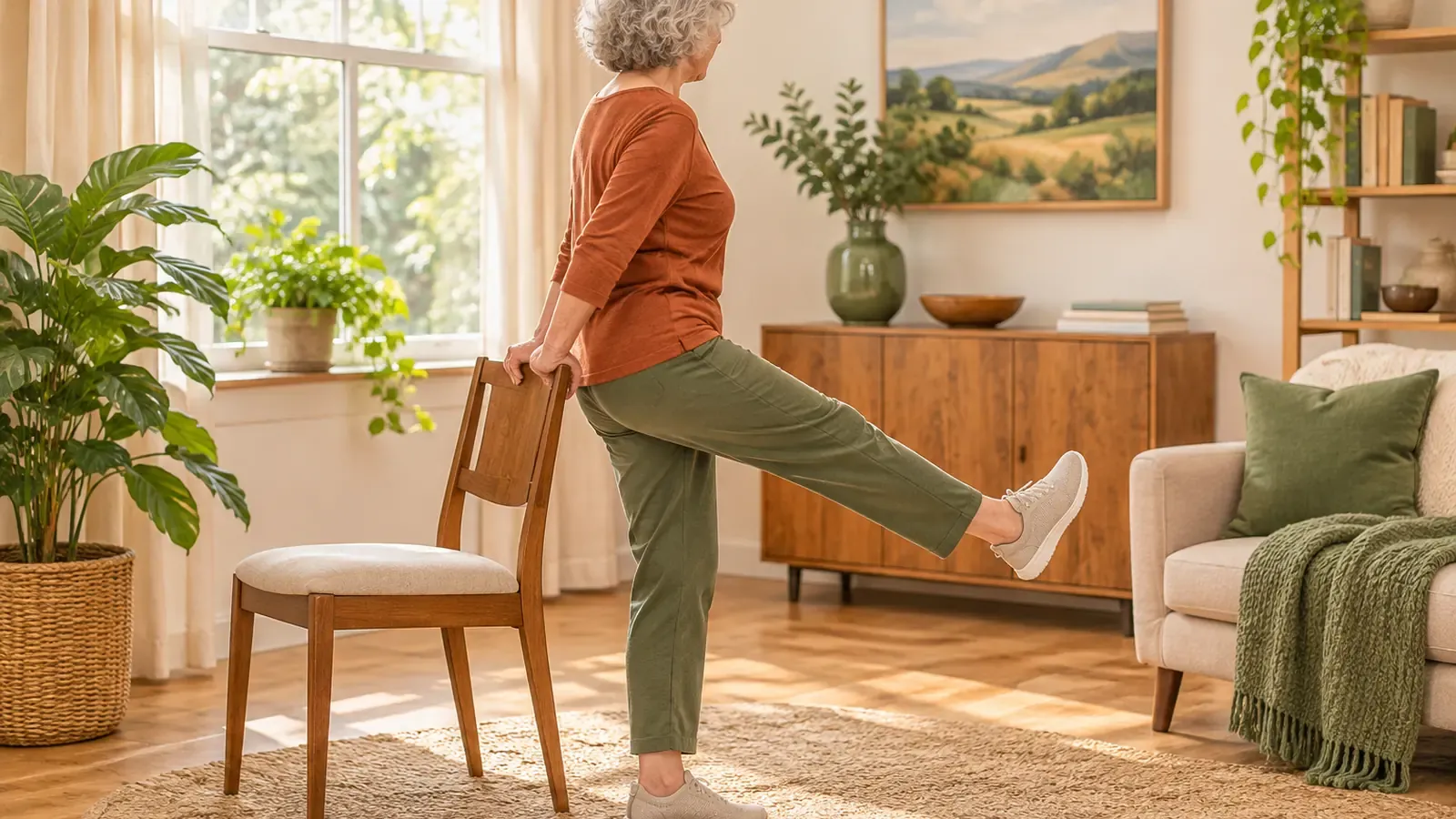
For people who don’t exercise, the official physical activity guidelines often feel overwhelming: 150 minutes of moderate or 75 minutes of vigorous activity per week, plus strength training – that’s a lot when, after eight hours at a desk, your only ambition is the couch. A research team led by Australian epidemiologist Emmanuel Stamatakis has therefore been asking a different question: what is the minimum amount of activity at which mortality risk drops measurably? The answer is surprisingly modest – and it has a name: VILPA.
What VILPA means
The acronym stands for Vigorous Intermittent Lifestyle Physical Activity – brief, strenuous bursts of movement woven into everyday life. We’re not talking about a structured run or a session at the gym, but the kind of activity you’d do anyway: walking up a hill, taking the stairs with heavy groceries, running to catch a bus, digging in the garden.
The term emerged in a 2020 review by Stamatakis and colleagues and named a gap in physical activity research. Until then, the orthodoxy held that health benefits only kicked in with structured, planned activity of at least ten minutes at a time. That assumption came from an era when activity was mostly measured via questionnaires. With the rise of activity trackers and wearables, researchers could suddenly capture, second by second, how people actually moved – and discovered that most strenuous moments in a non-athlete’s day last less than two minutes.
The headline study: 4.4 minutes a day, 26 percent lower mortality
In 2022, the Stamatakis team published an analysis of UK Biobank data in Nature Medicine. More than 25,000 participants wore a wrist-mounted accelerometer for a week; their health was tracked for the next seven-plus years.
The key findings:
- Just three VILPA episodes a day, each about a minute long, were associated with substantially lower risk of dying or developing cardiovascular disease in the years that followed.
- The median participant spent only 4.4 minutes a day in this intensity category. Those people had roughly 26 percent lower risk of premature death compared to people with no VILPA at all.
- The effect was nearly identical to that of structured runners or other exercisers with comparable activity time.
A follow-up study in the European Heart Journal (Ahmadi et al.) confirmed the order of magnitude in a larger sample (71,893 people) and extended the picture to cancer incidence: as little as 15 to 20 minutes per week of vigorous activity was enough to lower cancer risk by about 17 percent.
What’s happening physiologically
Why are such short bursts enough? Several mechanisms work in concert:
- VO₂max response: short, intense efforts elicit a near-maximal oxygen uptake response almost as fast as longer training does. The heart pumps at full capacity, the mitochondria in muscle cells are pushed into energy production.
- Insulin sensitivity: even single intense episodes improve glucose uptake into muscle cells for the next several hours.
- Endothelial function: the inner lining of blood vessels responds to every intense bout with improved function. Long term, that protects against atherosclerosis.
- Mitochondrial adaptation: weeks of repeated VILPA stimulation lead to more numerous and more efficient mitochondria – similar to interval training in a gym.
A caveat: these effects only show up when the effort is genuinely intense. A leisurely walk doesn’t cut it. Rule of thumb: you should be breathing hard enough that short sentences feel difficult – during a normal conversation, you’d need to pause.
Women benefit more than men
A 2024 follow-up published in the British Journal of Sports Medicine surfaced a striking detail: the protective effect of VILPA on cardiovascular events was very clear in women, less clear-cut in men.
In non-exercising women, a median VILPA dose of 3.4 minutes per day was associated with a 45 percent lower risk of major adverse cardiovascular events. As little as 1.2 to 1.6 minutes per day cut the risk of heart attack and heart failure by roughly 30 to 40 percent. In men, the dose-response curves were flatter and statistically less unambiguous.
One possible explanation: women experience the same everyday activities as relatively more demanding, because their average cardiorespiratory fitness tends to sit slightly lower. The same flight of stairs that registers as moderate effort for an athletic man may already be a VILPA episode for an inactive woman. As a result, women cross the threshold at which the body’s adaptation mechanisms switch on more often.
This doesn’t mean men don’t benefit from incidental activity – they do. It’s just that the pure VILPA lever appears smaller for them, because their everyday efforts less often reach vigorous intensity.
How to apply it
How do you build this into an ordinary day? Three approaches that studies have shown to be feasible:
Upgrade the walk. On the way to the bus stop or while walking the dog, every few minutes ramp up the pace for 30 seconds – fast walking, almost jogging, ideally uphill. Three such bursts a day are roughly the threshold dose from the studies.
Stairs over elevator. If your office is on the third floor and you take the stairs at speed, you’ve had a small VILPA episode without even thinking about it. With a backpack or shopping bags, even more so.
Use heavy housework. Chopping wood, digging in the garden, moving heavy furniture, scrubbing windows hard – any task that gets your heart noticeably faster and your breathing deeper counts.
The Stamatakis team itself doesn’t recommend keeping a detailed log. It’s more about cultivating a stance: deliberately ramping up the intensity of everyday movements rather than minimising them.
What VILPA isn’t
Three caveats matter.
VILPA doesn’t replace strength training. The studies cited concern cardiovascular mortality and cancer incidence above all. Building muscle and bone health – both critical with age – still need targeted resistance work. Two strength sessions a week cover the essentials.
VILPA isn’t a free pass for otherwise sedentary days. The effects partially address the mortality risk associated with inactivity, but not fully. If you sit eight hours and try to compensate with two flights of stairs, you’re missing that prolonged sitting carries independent risks – for back issues, metabolism, and cognitive function.
Pre-existing conditions warrant a check-in. People with heart disease, poorly controlled blood pressure or musculoskeletal issues should discuss intense activity bursts with their doctor first. The science doesn’t recommend VILPA as a therapy – it’s a prevention lever for the general population.
Bottom line: If you have little time or little appetite for structured training, three to five minutes of brief, intense everyday activity a day can make a measurable difference to your health. It’s not a miracle – but it’s probably the lowest-bar recommendation sports medicine has produced in years. The one condition: it has to actually be hard. A leisurely stroll won’t deliver this effect.