The hashtag fibermaxxing has been doing the rounds on TikTok for a while now. Young people film themselves stirring oats with chia seeds, berries and flaxseed for breakfast, post lentil stews, or show how they hit 40 grams of fibre a day. Sounds like the next short-lived nutrition trend, doesn’t it? Not quite. Because the central idea behind it – eat more fibre – is one of the best-evidenced recommendations in nutrition science. It’s just remarkably poorly implemented.
Where most countries actually are
The German Nutrition Society and similar bodies in the US, UK and across Europe have for years recommended at least 25 to 30 grams of fibre per day for adults. That recommendation was reaffirmed in 2022 after an updated review of the evidence – it’s on solid ground.
The reality looks different. In the United States, average daily fibre intake sits around 17 grams. In the UK, around 15 grams. In France, 17. In Germany, women average 18 g and men 19 g per day. In China, just under 10 grams. About three quarters of the population in most high-income countries falls short of the recommendation.
There’s a good reason nutrition scientists tend to shrug rather than warn at the trend hashtag: it’s drawing attention to something most people have too little of, not too much.
What fibre demonstrably does
The evidence base for fibre is unusually clear. A 2019 Lancet meta-analysis (Reynolds et al.) reviewed 185 prospective studies and 58 clinical trials. The findings:
- People who eat 25–29 g of fibre per day have roughly 15 to 30 percent lower risk of dying from cardiovascular disease or developing colorectal cancer compared with people on low-fibre diets.
- Going above 30 g per day appears to bring additional benefits, particularly for cholesterol values and diabetes risk.
- Protective effects show up across heart attack, stroke, type 2 diabetes, obesity, high blood pressure, breast cancer and – most clearly – colorectal cancer.
A comprehensive 2023 analysis in Frontiers in Nutrition confirmed the magnitude in a broader dataset: each additional 10 g of fibre per day is associated with about 10 percent lower mortality risk.
These are effect sizes that nutrition research rarely produces this cleanly.
How fibre actually works
Fibre is the part of plants we mostly can’t digest. It contributes very little energy but affects metabolism in several places at once.
Satiety and blood sugar. Fibre-rich meals stretch the stomach, slow gastric emptying, and slow glucose absorption into the blood. That keeps you full longer and flattens the post-meal blood sugar curve – both relevant for weight control and diabetes prevention.
Cholesterol reduction. Soluble fibres like beta-glucans (oats, barley) or pectins (fruit) bind bile acids in the gut. The body has to make new bile acids from cholesterol, which lowers blood cholesterol levels.
Gut microbiome. In the colon, many fibres are fermented by bacteria. The process produces short-chain fatty acids, especially butyrate. Butyrate is the colon’s primary energy source and has anti-inflammatory effects – a central mechanism by which a high-fibre diet lowers colorectal cancer risk.
Stool volume. Insoluble fibres like cellulose bind water and bulk up stool. That speeds up transit and prevents constipation.
Soluble vs. insoluble – do you need both?
The classic textbook split between soluble and insoluble fibre is real, but in practice less critical than it’s often made out to be. Anyone eating a varied range of plant foods automatically gets both:
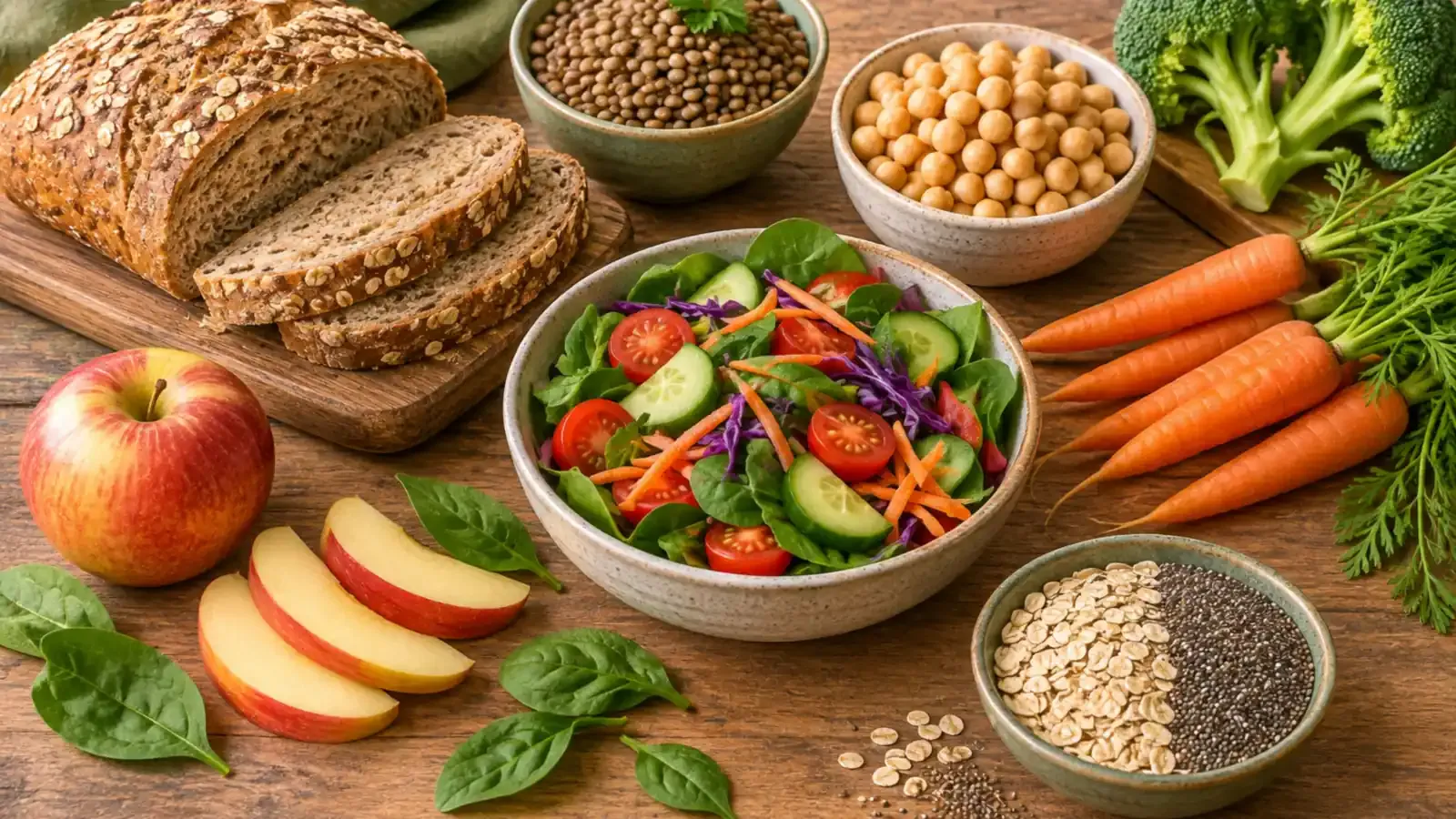
- Soluble fibre (satiety, blood sugar, cholesterol regulation): oats, barley, legumes, apples, pears, carrots, psyllium husk
- Insoluble fibre (stool volume, gut transit): wholegrain wheat and rye products, nuts, seeds, many vegetables, fruit skins
A rigid 2:1 split of insoluble to soluble, as sometimes circulated, isn’t scientifically required. What matters more is variety of sources – different plants supply different fermentable substrates and feed different beneficial bacterial strains in the gut.
How to actually hit 30 grams
The jump from 17 to 30 grams looks more manageable when you map it onto typical meals. Sample day:
- Breakfast: 60 g rolled oats (6 g) with 200 g berries (5 g) and 1 tbsp flaxseed (3 g) – 14 g
- Lunch: lentil soup with 100 g cooked lentils (8 g) and 1 slice wholegrain bread (3 g) – 11 g
- Snack: an apple with skin (3 g) and 30 g almonds (3 g) – 6 g
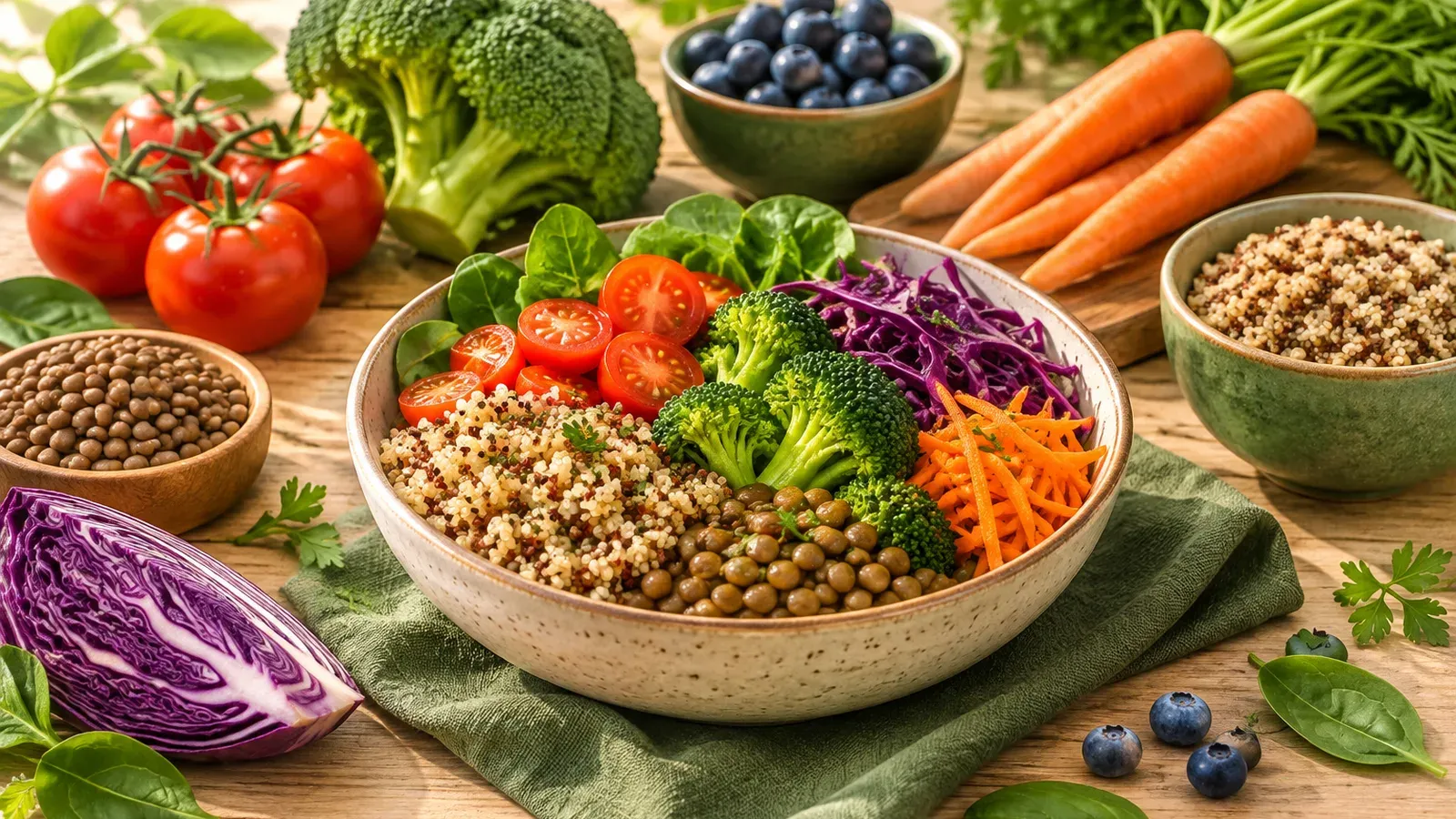
- Dinner: roasted vegetables with 200 g broccoli (5 g) and 100 g cooked chickpeas (6 g) – 11 g
That comes to 42 grams – plenty of headroom for days when it doesn’t quite work out.
The biggest practical levers:
- Wholegrain over refined. Wholegrain pasta delivers about 8 g of fibre per portion, refined pasta only 5 g. A slice of wholegrain bread has roughly twice as much as white. A single swap stacks up.
- Build in legumes. Lentils, chickpeas, beans are the most efficient fibre sources of all – 8 to 15 grams per 100 g cooked.
- Berries and pears instead of bananas and watermelon as your default fruit. Berry fruits are denser in fibre.
- Nuts and seeds as a snack or topping. A handful of almonds a day brings 3 g.
But: jumping suddenly from 15 to 35 grams risks bloating, cramps and sometimes the opposite of what you’re going for. A staged increase over two to four weeks works better, combined with adequate fluids (at least 1.5 to 2 litres per day). The gut needs time to adapt to the higher fermentation load.
When fibre supplements make sense – and when they don’t
TikTok also pushes psyllium husk, inulin powder, acacia fibre and similar products. In principle they work – psyllium husk is even well-evidenced for cholesterol reduction and gut health. But two points matter:
They don’t replace whole foods. A bowl of oats with berries delivers not just fibre, but vitamins, minerals, plant compounds and microbiome variety. A powder in water doesn’t.
Caution with pre-existing conditions. People with irritable bowel syndrome can get worse on highly fermentable soluble fibres like inulin or FOS. Less fermentable sources like psyllium husk are sometimes better. With an active diverticulitis flare or chronic inflammatory bowel disease, fibre strategy should be discussed individually with a doctor or dietitian.
What fibermaxxing leaves out
One point that often goes missing in the social media discussion: fibre doesn’t work in a vacuum. Eat 35 grams of fibre but drink too little water and you can end up with the digestive equivalent of a traffic jam. Get most of your fibre from heavily processed “fibre-fortified” bars and cereals and you tend to bring along a lot of added sugar.
The often-heard “more is better” argument also only holds up to a point. Above 50–60 grams of fibre per day, additional benefits are minimal but digestive complaints rise. And for some minerals (calcium, iron, zinc), very high fibre intake can mildly impair absorption – not dramatic, but relevant when supply is borderline.
Bottom line: Fibermaxxing is a trendy name for an old, well-evidenced recommendation. Most people in Western countries eat substantially less fibre than is good for them, and getting to 30 g a day is doable with a few targeted swaps – wholegrain over refined, legumes several times a week, berries instead of grab-and-go sweets. Make the switch and the benefits are well documented. Overdo it and you’ll at least have a grumbly stomach. As ever: pace yourself, and keep an eye on your water intake.